Marketing is Messy
It’s a mess of art, business and humanity. It’s persuasion, filtered through spreadsheets, interpersonal dynamics and decision-making. It’s really a wonder that any of it works at all.
As we know, most of it doesn’t work. I get a small kick out of telling unfamiliar friends that a 2% click-thru-rate is cause for celebration.
The problem is, companies hate messes — they want certainty and predictable outcomes. Marketing tries to provide this by leaning on measurement, data, and project management.
Companies prefer to treat marketing as an engineering problem, a machine where you adjust the inputs based on measurement feedback to get a predictable output.
It doesn’t work that way. Marketing is (or should be) essentially gambling. You take calculated risks, hoping that one of your long-shots pays off while minimizing the downside. There’s little point to gambling if you try to play it safe. You lose by avoiding losses.
It’s messy because marketing is about humans and humans are messy. Externally, it’s difficult to predict what tactics will work on your audience and control any of the dozens of environmental factors. Internally, office politics, cognitive biases, and processes skew every output.
The way through is radical honesty. You have to be honest about your product, position, performance, problems and people. You can’t take calculated risks without an honest read of the situation, and you can’t have that in an organization that punishes honesty.
The issue is honesty is costly, and companies develop defenses against doing anything costly. Being outwardly honest is often punished by higher-ups who wish to protect themselves, and this candor can rub people the wrong way. Complacency is rewarded, and growth stalls. No one likes to directly acknowledge the power dynamics that affect work, but being honest about them helps create smoother outcomes.
Let’s talk about why strategy matters so much, why it’s so messy, and what to do about it.
What you work on matters more than how
While we’re being honest, the real job of marketing is deciding what to work on.
There is a tension in the business world between focusing on ideas vs execution. After all, the execution (businesses) are sold for billions while there is only a middling marketplace for selling ideas (patents). So the thinking goes, “focus on execution, you can pivot the idea later”, favoring speed over everything else.
Marketing works a little differently. If we have to use math in marketing, let’s use this: Results=(work*time)^strategy.
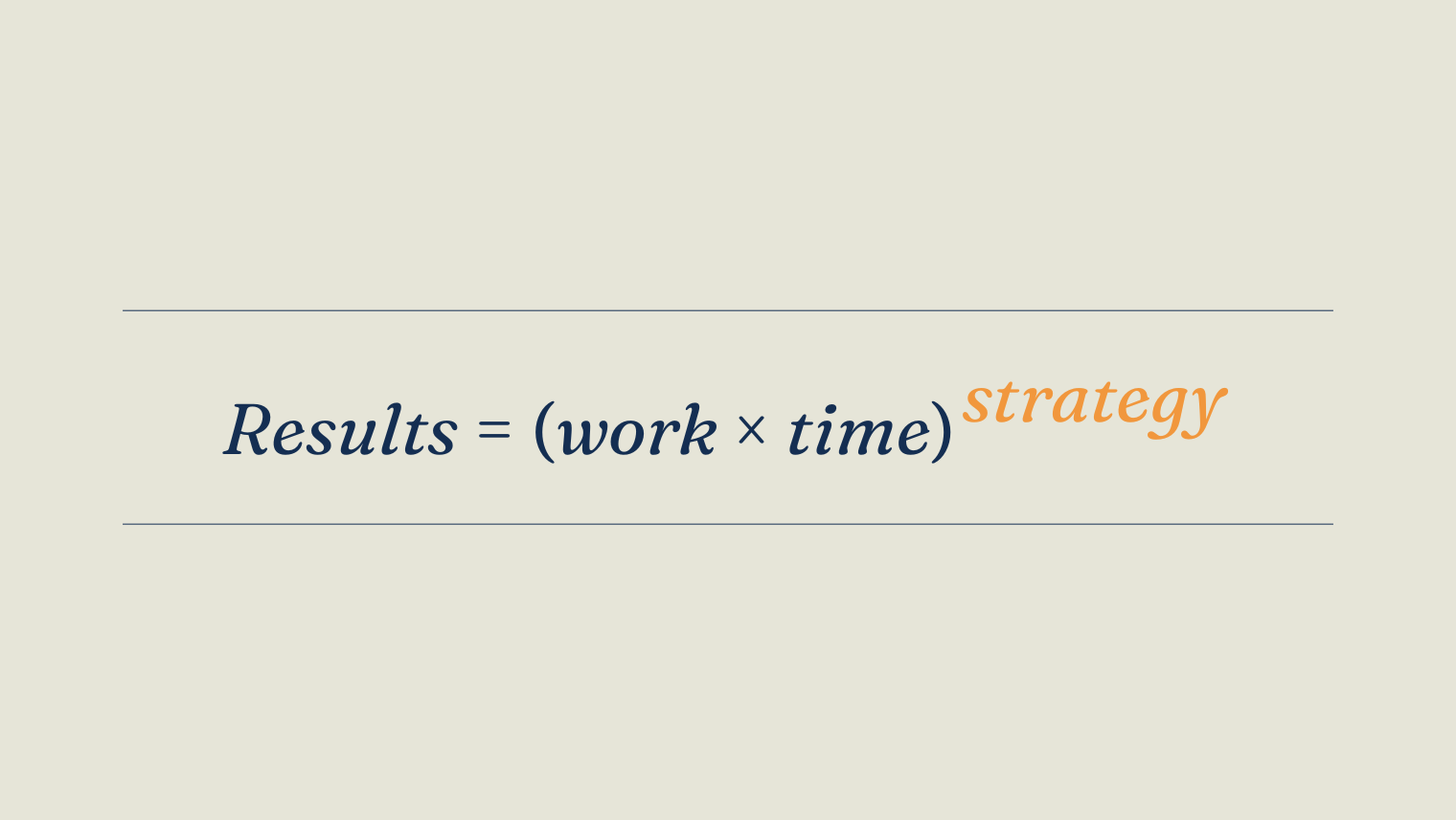
You can have great execution, budget, and generous timelines, but none of it matters if the strategy is wrong. Your strategy is the exponent, get it right and it multiplies your effort. Get it wrong and it is all for naught.
Marketing takes more time, and involves more uncertainty. It’s more the watering of a plant than the running of a race.
“There is nothing so useless as doing efficiently that which should not be done at all.” — Peter Drucker
Ideas and execution are not competing but complimentary. Choosing what to work on is difficult. To get it right requires honesty, conviction, taste and even courage. So give it the execution it deserves.
The issue is that planning and project management feels secure because it’s relatively straightforward and the momentum feels good. On the other hand, strategy feels scary because you’re pairing uncertainty with commitment.
But if we’re leaning into honesty, that’s exactly why you have to lean into those feelings. Planning is a list of activities; strategy is a choice that rules things out, and that always feels uncomfortable.
I’m a fan of Rumelt’s “kernel of good strategy”. All good strategy starts with a clear-eyed diagnosis of the problem, identifying your guiding policies, and putting a series of coherent actions in place.
Most companies are not honest with themselves at this stage. Goals are not a strategy, and neither are tactics. “Grow MQLs 30% by launching a podcast” without a solid theory of the problem leads to ineffective action.
What leads to effectiveness is recognizing this difference, and knowing how to act on it.
What to work on
Strategy is about focus. And ultimately, execution should be, too. This is where honesty about what does and doesn’t matter comes in.
Most of the “work” doesn’t matter. Minor copy edits, changing the color of a CTA button, updating the project management tool. It’s majoring in the minors, busywork that doesn’t move any needles.
Marketing work isn’t a machine, but it is a system. Donella Meadows, the original systems thinker, has her list of highest leverage points to change a system. The highest level of impact and abstraction is realizing that these systems are made-up and changeable. At the more practical levels, it’s about changing the goals, rules and structure of the system.
Moving information around and holding meetings matters little if you haven’t had an honest evaluation of the system you’re operating in. What are the (un)written rules? What are the stated and actual outputs? Is the structure effective?
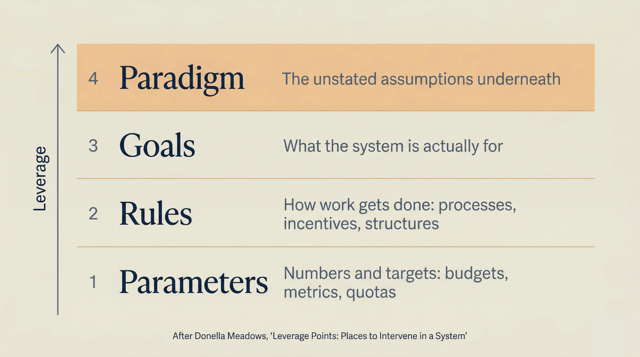
The strategic moves that would matter, admitting your offer is weak, changing what marketing is being asked to do, examining visible and invisible incentive structures — are the messy, meta moves that few people have the political capital or resources to make. So the team works on the easy moves instead, and the system stays stuck.
Think about it, have you ever been given a philosophical backing to the work beyond “increasing shareholder value”? Most marketers are never told what their function is within the system, and how it impacts the rest. That absence is a failure at one of the highest leverage points. A good strategy starts with defining the true task. “You are to increase long-term brand equity through value-add content and loyalty initiatives, success is measured YoY”.
Most of what you do doesn’t matter, so the approach is to find the small number of decisions that do. Meadows tells you that they’re usually at the level of goals and structure, Pareto tells you they’re usually about 20% of your inputs. Focus is the point. Identify your 20% of inputs, within these, there is another layer of 80/20 — factors that influence your inputs. Protect and invest in these ruthlessly.
Work on problems
Every business exists to solve a problem. What does yours solve? If we’re honest, that’s what your audience cares about, how well you can solve their problem. Not your new website, campaign, or new locations. Product people love to say, “love the problem, not the solution”, the same approach applies to marketing.
There is a difference between simple and easy. Marketing can be as simple as: “Empathize with the problem your audience is having to earn attention. Demonstrate why your solution is trustworthy. Convert them into the next stage along their journey.”
That doesn’t mean it’s easy. You will have to do careful research and experimentation to nail the execution, but the focus brings the simplification that allows you to be effective in the first place.
Honesty is expensive
Companies that are full of competent, well-meaning people still combine to create bad strategy. Why? The hardest thing about strategy isn’t analytical, it’s political. Humans are political, but especially in structured organizations where the web of perception, status and incentives are so pervasive.
Good strategy requires an honest understanding of the world, your company, and yourselves. It requires someone in the room saying what no one wants to hear. “Our product isn’t differentiated enough, this campaign won’t work, we don’t have the resources to succeed”.
The person who says it pays a political cost by violating the shared story of excellence and progress that provides motivation and cohesion to the team. Complacency is free. Cheerleading is rewarded. Over time, honesty is selected out and the system stays stuck.
This isn’t just a pattern of human behavior, it’s how systems work. Donella Meadows, the systems thinker, had another potent observation: in any system, the most powerful interventions are also the ones the system fights hardest to prevent.
The easy interventions — adjusting budgets, tweaking targets, optimizing tactics — are the least impactful. The powerful ones — changing the goals of a system, surfacing the assumptions underneath it, redesigning its rules — are the most. They’re powerful because they’re uncomfortable, difficult, and rarely acted on.
There’s a name for this. Chris Argyris calls these “defensive routines”, the elaborate ways organizations develop to avoid threatening information. And “skilled incompetence”, people becoming experts at not noticing the things that would force them to act.
Honesty about the situation is the most powerful intervention available to a marketing team. Which is exactly why organizations develop such elaborate defenses against it.
I’ve experienced this from the inside
At Techstars, I helped manage our “Community Programs” — grassroots startup education/competition events that took place across the world. The angle for us was that it was a) aligned with the “Give First” brand, b) good brand exposure and c) decent talent and investment pipeline.
I was tasked with increasing the “success” (ticket sales and NPS) of these programs by working with the organizers. However, we didn’t pay the organizers (who had to put in 100+ hours of collective free labor) and the organizers didn’t pay us. No leverage or accountability, and thus no reliability. As a large loss-maker for the business, we didn’t receive many resources to help in other, non-monetary ways. Of course, numbers declined across the board.
Now, if we were honest with ourselves, we could’ve said, “We rely entirely on the free labor of our passionate organizers. We can admit we don’t serve them well, and that without pay, cannot make them perform. Let’s strategize around how to focus and reward organizers instead of pushing more of them to sell more tickets for us”. But admitting we had the structure wrong would’ve been costly in terms of reorganization and reputation.
At CU Boulder, I managed email marketing for “Advancement” (latin for fundraising). Our leadership insisted that it was a business. Using business terminology, business processes and measurement.
But we sold nothing, had fixed internal clients (campus partners) we couldn’t push back on, and were beholden to a fixed audience (alumni, parents, faculty). We were essentially an internal agency with none of the leverage or opportunities agencies typically have.
If we were honest about the realities of our situation, we would’ve said, “We’re a services operation inside of a fundraising department inside of a public university. We exist to help various campus departments raise money, if we’re not useful and compliant to their needs, we lose our justification to exist”.
Admitting that would’ve meant dropping the business labels and acknowledging the frustrating, low-status position we all found ourselves in. So we didn’t.
In both cases, perfectly competent people refuse to name the structural reality of the organization because doing so would require changing the structure they enjoyed, or admitting that the existing strategy doesn’t work.
Failure to face what we were and to honestly approach the challenge showed up across both organizations in results, employee churn, and more.
Typical failure modes
1 — Decision by committee
Committees are “defensive routines” made structural. It’s a diffusion of responsibility, so each individual can feel less accountable for the outcome, which is why no one fights for the bold call. The output is undifferentiated, ineffective marketing.
“If you ask 10 people to agree on an ice cream flavor, you get vanilla.”
To be clear, meeting to make decisions is not an inherently bad thing. You need the right leadership and rules in place to incentivize bold and accurate decision-making.
2 — Short-termism
Teams chase measurable, short-term results because measurability and causality are defensive mechanisms. Long-term results are too difficult to tie to individual actions. Nobody ever got fired for a healthy-looking dashboard.
A 2013 study of hundreds of effective companies showed that brand building drives 60% of long-term business effects. Then, updated research in 2022 showed that 95% of your marketing should be brand-building for the out-of-market buyers. But most companies invest in reverse, because quarterly activation data is legible to CFOs and brand isn’t.
(I’ve written separately about why this happens. Most marketing teams have traded effectiveness for measurability, and killed their results in the process — read it here.)
The work is patient. You water plants for a long time before anything sprouts. Teams that can’t tolerate the wait kill their brand-building before it has a chance to show.
3 — Research as reassurance
Customer personas, surveys, competitor analysis, best-practice docs. This is real, occasionally useful work, but the function is emotional more than practical. It lets teams defer and delay decisions by outsourcing it to the “research”.
David Ogilvy said it best, “The trouble with market research is that people don’t think what they feel, they don’t say what they think and they don’t do what they say.”
We know now that stated and revealed preferences can be far apart.
There is an important distinction between research that observes what people do and seeks to understand why — behavioral, psychological, friction analysis. And the research that tries to predict what people think they’ll do – surveys, focus groups, personas. The first is indispensable, the second is a defense against uncertainty. That’s why an honest understanding of the environment that creates conviction in your approach is so important.
External Pessimism, Internal Optimism
I’ve struggled with pessimism in my career. I find it valuable to highlight flaws and potential causes of failure, I’m good at chiseling away at ideas until they resemble something valuable. I lean on base-rates of failure and am too painfully aware of the planning fallacy. Coworkers perceived this as poor attitude and negativity.
I grappled with how to balance rigor with positivity, until I found this approach. You have to be externally pessimistic. Be brutally honest about the situation, the obstacles, the things that won’t work and why. Then, pair it with internal optimism. Commit to your plan with confidence, knowing it’s wrong in ways you cannot see but can figure out as you go.
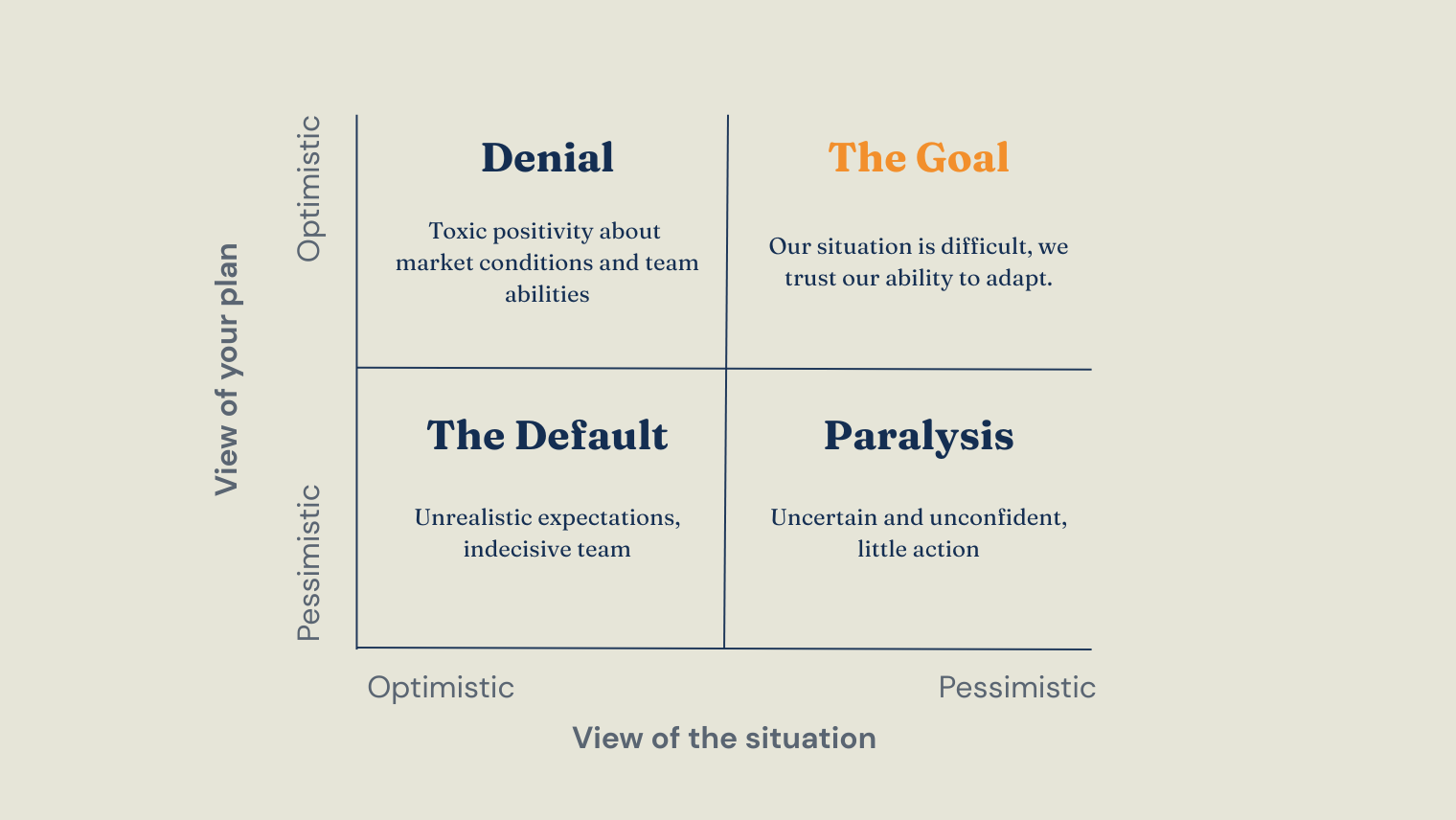
Most organizations do the opposite: optimistic about the situation (toxic positivity, glossing over structural problems) and pessimistic about their own plan (hedging, committee-ing, never fully committing).
This inversion is the whole game.
Building for honesty
Make diagnosis indispensable
Diagnosing your real problem and your strategy to tackle it determines the rest of the work and your long-term success, so give it the time and attention it deserves before you do anything else.
Most marketing starts at step two. A goal, with tactics, with little about why the team believes this is a problem worth solving and why they believe the approach will work.
The point is to have the difficult conversations while they’re still cheap. It’s too costly and ineffective to change direction later, so do the heavy lifting upfront.
Write the diagnosis down. State the problem, who has it, what assumptions you’re making and what you’d have to be wrong about for your plan to fail.
Prioritize and protect
Identify and work at the highest leverage points you can reach, and defend them against the organizational tendencies that pull you away.
A small number of your decisions and inputs are responsible for most of your impact. Identify the 20% of factors that influence the 20% of your most impactful inputs and ruthlessly refine them to drive your progress.
High-leverage decisions are also the ones nobody has the political room to touch. So most teams spend their effort at the bottom of the list because that work is safe to do without much permission or effort. People spend more time on weaknesses because they’re often low-hanging fruit. But the right strategy is almost always to develop your strengths further. These are your competitive advantages and moat.
Defend by getting buy-in from the higher-ups on what you’ve identified well ahead of time, and reference it throughout your projects. When someone tries to dilute a priority later, point to the agreement and have them justify the trade-off that will occur.
Appoint the asshole
It’s politically costly to be the truth-teller, so eliminate the cost by appointing someone to be rewarded instead for being brutally honest.
The Catholic Church figured this out centuries ago by appointing the “Devil’s Advocate”, the military calls it red-teaming. If you know the group will instinctively converge on consensus, you assign someone to dissent on purpose, and you protect their standing so the dissent doesn’t cost them.
Pick a non-senior person with the right temperament and knowledge, and empower them to surface what nobody else will say, name the assumption everyone is depending on, or call out poor thinking — and then reward them for it. Do it right and it’s not a burden but a relief. Both functional and fun.
Have Heart
This stuff is hard. Life is hard, work is hard, marketing is hard. It’s not enough to have good ideas, you have to fight for them to get approved and then work hard to ensure they get the execution they deserve.
We cope with the difficulty by avoiding the truly difficult, costly work and doing feel-good, low-impact work. We avoid honesty with ourselves and others. We tell ourselves how good our ideas are and we don’t dare criticize the plan or our superiors. We’re all happy to exist inside the story we’ve created, whether fiction or factual.
The teams that win are the ones that will look at their situation honestly, make a call with incomplete information but trust in their judgment, and commit to it long enough for it to work. They also acknowledge the messy realities of the system they operate in.
This all requires courage. To do more work, to trust in yourselves, and be unpopular. The frameworks in this piece are just a way of making that courage easier to summon. I hope you have the courage to use honesty as your new marketing strategy.
Intellectual debts to pay: Donella Meadows and her “Thinking in Systems” book which I’ve turned to repeatedly. Chris Argyris’s work on defensive routines and skilled incompetence gave language to patterns I noticed but couldn’t name. Professors Binet, Field, Lombardo, Weinberg and Sharp for their brand-building research to provide the empirical backing for long-term thinking. Thanks, team.