A cheetah stalks through the tall savannah grass, approaching a herd of gazelles. A misplaced step snaps a twig, alerting its would-be prey. They bolt in different directions, eager to get a head start on the world’s fastest land animal.
Except for one, which begins to repeatedly leap high into the air. Is it dumb, confused, or suicidal? No, it is the fittest and smartest of the bunch. The gazelle is communicating, “I’m so fit that I can jump this high with little cost. Don’t bother chasing me, go after the others if you must.” It uses less energy than a full chase and prevents the risk of being eaten (if it works).
This behavior in gazelles is called stotting, and it is an example of signaling in the animal world. But not just any signaling, honest signaling. Jump height cannot be faked, and the cheetah knows exactly what it means.

Across the animal world, signals are constantly emitted and received to help navigate the world, to survive and thrive within it. From the rattle of a snake’s tail to the colorful feathers of a tropical bird, they’re everywhere.
Some signals are dishonest. A pufferfish inflates itself to appear large and dangerous despite no fighting ability. A hoverfly mimics the coloration of bees and wasps but possesses no sting.
Humans signal, too. We evaluate the honesty of signals to see how smart, strong, and pleasant each other are. The best shortcut is looking for costly signals, things not easily faked.
The peacock’s wings are resource-intensive, requiring a consistently healthy diet to produce large and colorful feathers. They also cost it its ability to fly. A male peacock’s fitness cannot be faked; the female knows exactly what to look for.
Conscious or not, humans are constantly emitting and detecting a dense stream of signals from one another. The clothes we wear, the words and tone we use, the things we buy, all communicating things about ourselves that we want others to know.
A Rolex to show that you have disposable money to spend on something minimally useful, or a t-shirt in the boardroom to show people that you’re powerful enough to get away with it. Signals flying back and forth, all around us.
You’re in the signaling business
As political animals, our signaling skills have been well-honed and become part of the background of our cognition. Whether we want to (or admit it), we are constantly judging others and worried about being judged ourselves. Indeed, we are frighteningly good at reading each other.
While some animals have one or two strong signals such as our gazelle, humans have hundreds to create and interpret. We’re the most judgy species on earth, evaluating each other on nearly every choice. With a species that uses social status as a currency to get almost everything we want, you get signaling behavior that is as natural as breathing.
Marketers often talk about “messaging.” “What’s our messaging strategy?” “What message does this send?” Carefully crafting copy. However, we’re actually in the signaling business.
A message is what you say, the signal is what the audience infers about you from how, where and at what cost you said it.
Take this year’s “Serena Williams is on Ro” Super Bowl ad as an example.
The message of a Super Bowl ad might be that you can easily lose weight on GLP-1 drugs. The signal is multi-dimensional. Viewers know that Super Bowl ads are expensive ($8m on average in ‘26), so it signals that a) you have enough money, which signals success and legitimacy, and b) that you believe strongly enough to spend millions on the product, signaling trust. And in this case, getting the most successful female athlete of all time to feature is another signal. “If she trusts it, surely I can.” These are signals easily interpreted as honest.
Not all costly signals are created equal
Okay, we can’t and shouldn’t all spend millions on Super Bowl ads in order to effectively signal and earn audience trust, and we know that asking for more ad budget is rarely the answer.
Here’s the good news: there are more costs than just monetary, and in fact, spending more money can actually backfire in the eyes of your audience. As ever in marketing, the key is understanding your audience amidst the larger context of human psychology.
According to psychology professor Geoffrey Miller, there are three types of signals.
- Conspicuous waste: spending resources for the sake of showing you can afford to spend them frivolously. A diamond-gold necklace, or a splashy ad campaign.
- Conspicuous precision: signaling intelligence, taste and craft through buying exceptional quality that exceeds the functional. A Mercedes AMG or a meticulously designed presentation.
- Conspicuous reputation: leveraging the brand associations that exist in others’ minds to elevate our own status. An Ivy League degree or celebrity endorsement.
Different audiences respond to different signal types in different ways. To some, the mere (perceived) cost of a campaign will be enough to be impressive. To others, if the cost seems disproportionate to the product category, it’s interpreted as desperation. “Why do they need to try so hard? Something’s off.” (Research Study)
A lot of marketing defaults to flash. Bigger budgets, more spend for more impressions, attention-grabbing campaigns. But your audience isn’t a general consumer scanning billboards or in-feed ads. They react to precision, to craft. Demonstrating tasteful expertise is the signal you want to send.
Common Knowledge
Cost explains why people believe you. But it doesn’t explain why people buy. For that, you need to understand what makes a brand worth signaling with, and that requires common knowledge.
Humans are constantly concerned with what our choices signal about us, how we’re perceived in the minds of others. We want to know what the people we hope to impress think about certain brands or products.
Signals are only effective when others know how to interpret them. There’s a reason we distrust people who are sending “mixed signals.”
A predominant view of marketing is that it works via “emotional inception.” People love to say “people don’t buy things, they buy feelings,” or that by activating emotions (hope, fear, lust, envy, pride) you can move people towards a purchase better than activating logic.
This is true to an extent, but it’s only part of the picture. People are more motivated by “capture every moment of your child’s life” than “this phone has a 216GB memory.” But when it comes to more conspicuous consumption, what matters more is common knowledge of the item.
It’s not enough to know that an iPhone has the best camera. You need to know that everyone else knows it, too. That recursive awareness is what gives brands social meaning that motivates purchases.
The real mechanism is cultural imprinting. Marketing changes the shared cultural meaning of a product, which changes the signal that buying it gives to others. Everyone knows that everyone knows that iPhones cost more, have better design, and has seen the ads of creative people doing creative things with them. A purchase signals wealth, taste, creativity.
Think back to the Ro Super Bowl ad. Another reason it’s so effective is that Super Bowl ads create instant common knowledge. Everyone watches the Super Bowl and knows everyone else watches it. For a new product like an injectable weight-loss drug, gaining popular acceptance is key. Everyone knowing that everyone knows that Serena Williams uses it creates a powerful signaling effect.
This is crucial for the AI age
Michelangelo poured every ounce of himself into painting the Sistine Chapel. He built custom scaffolding, stood as he painted, craning his neck and shoulders for days at a time, causing excruciating pain that would leave his eyesight and spine permanently damaged.
He wrote to his friend, Giovanni da Pistoia,
“I’ve already grown a goiter from this torture, hunched up here like a cat in Lombardy… My stomach’s squashed under my chin, my beard’s pointing at heaven, my brain’s crushed in a casket, my breast twists like a harpy’s. My brush, above me all the time, dribbles paint so my face makes a fine floor for droppings!”

Now, AI can produce art that is as intricate and aesthetic as most fine art. But no one will fly across the world for the chance to see it. The value lies in its beauty and the cost that one of the most talented artists of all time paid to create it.
The point is, production quality, through talent, effort, time, is a useful costly signal for companies. It showed how seriously they took themselves, or at least how much they paid an agency. But remember that money is just one example of a cost. The time and effort a person with finite time takes to develop a skill, the further investment and personality they put into a project, the reputational stake they place in putting it into the world. These will always mean more to us than something generated in 20 seconds with a few dollars’ worth of tokens.
AI content is our hoverfly. It mimics the appearance of effort without the actual investment. It’s a dishonest signal, and audiences are evolutionarily primed to detect and detest this kind of faking.
“Slop” was the Merriam-Webster word of 2025. Consumer enthusiasm for AI-generated creator work has dropped from 60% to 26% since 2023, and 3x as many Americans reject growing AI use (49%) as embrace it (17%).
“The medium is the message,” Marshall McLuhan’s prescient observation that the medium imparts meaning onto the message is relevant. A hand-written letter in a nice envelope imparts far more meaning than an email, even though the content might be the same. The medium signals levels of care and effort.
What some companies think they’re signaling when they say they’re AI-driven or use AI-generated content is that they’re future-oriented, technologically-savvy, efficient. The signal often received, however, is that you spent almost no resources on it, which makes it a cheap and easily ignored signal.
AI makes it quicker and cheaper to produce content that appears high-effort and high-value. You can take a photo of an old soda can and give it photo-studio lighting, an artful background, design assets and snappy copy in a few minutes. The internet is already flooded with this kind of content.
How to signal honestly
So if raw spend has diminishing returns and AI has made production quality meaningless as a signal, what actually works? Here are a few approaches that can help calibrate your signaling so that people don’t just consume your marketing, they trust and act on it.
1. Play defense, not offense
You can split signaling into two camps: offensive and defensive. Offensive signals, “We’re the #1 platform for expense management” and “Trusted by 500 companies,” are seen as braggadocious and raise suspicion.
Defensive signals work by saying what you’re not, and get ahead of criticisms by acknowledging flaws or failures.
People evaluate your signals defensively when they feel like they’re being sold to. There’s an interesting paradox when it comes to persuasion: people are only willing to be persuaded if they think the presenter is not trying to persuade them. [Study]
We don’t trust people who are boastful because we know they’re sending dishonest signals and trying to earn cheap status. But think about most marketing, it’s inherently boastful and offensive signaling.
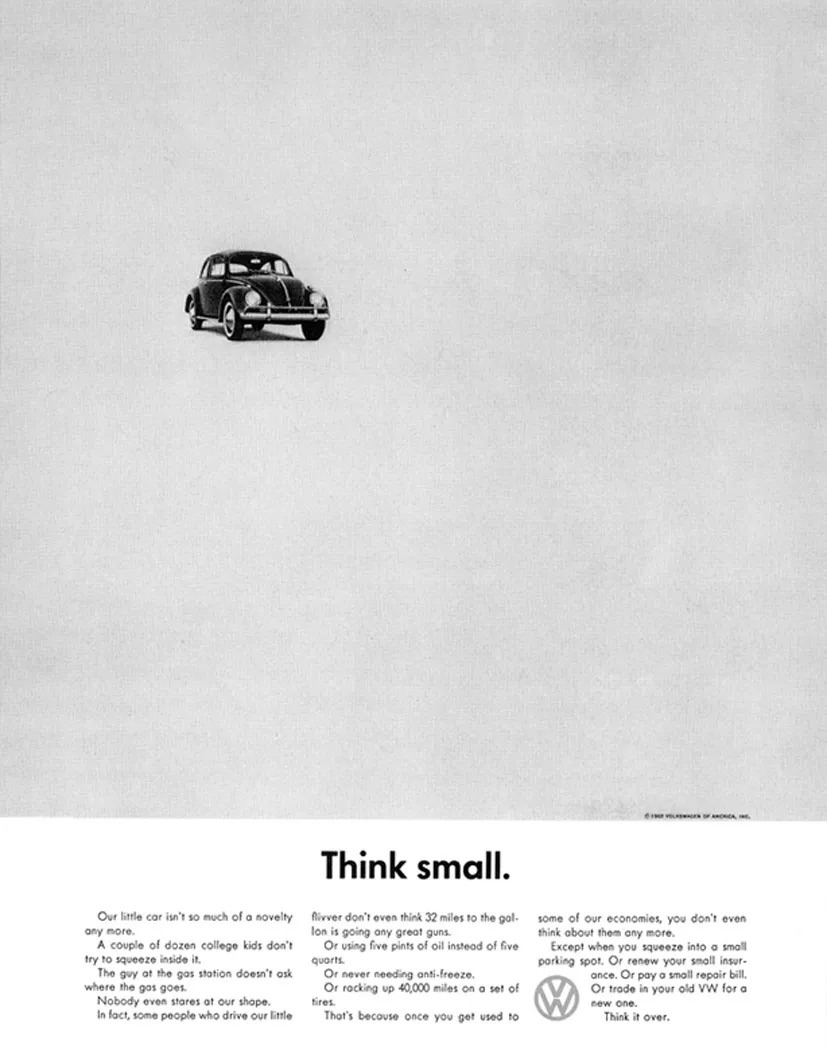
People trust messaging more when it admits small flaws. There’s a name for this phenomenon: the Pratfall Effect. Messages and messengers are seen as more human and trustworthy when they make visible mistakes.
This works because vulnerability itself is a costly signal. It costs the safety of the polished facade. It risks brand equity. That risk creates honesty because a brand that was actually bad would never draw attention to its weaknesses. Only a brand with genuine confidence can afford the pratfall.
The willingness to be imperfect is the proof of quality.

2. Counter signaling
As we pursue signals that help define ourselves and interpret others, the quality of the signal can begin to degrade, forcing people to either find newer and better signals, or react against the signal itself.
Louis Vuitton handbags with the large monogram logo were the ultimate status signal in the early 2000s. Then, they became ubiquitous and easily counterfeited, losing their signal value. Subtle, logo-less handbags became the new signal of sophistication and wealth.
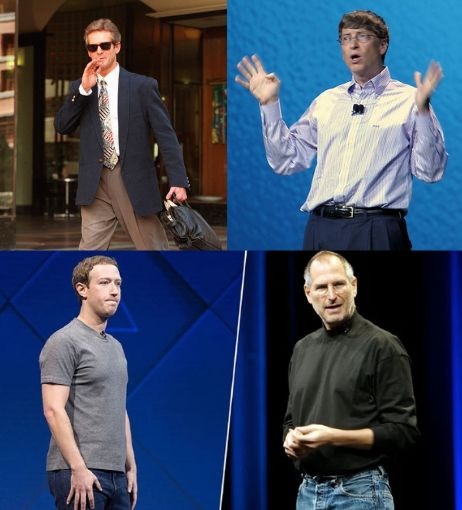
For decades, business attire, especially among elites, was the same: formal dress clothes. Then, the new generation of tech leaders needed a counter-signal to demonstrate their disruptive nature. Enter Zuckerberg’s gray t-shirt or Jobs’ black turtleneck, worn repeatedly. Signaling: “I’m so focused on important work that I’ve optimized away trivial decisions like fashion.” It also signaled, “I’m so important that I can get away with wearing casual clothes in high-stakes settings.”
Identify the dominant signals in your industry, and deliberately break them where useful. Every SaaS landing page has become the same: hero section with value-driven headlines, social proof via company logos and testimonials, feature explanations, CTAs.
Earn attention and trust by breaking the pattern in ways that still work, not just for the sake of it. Create a deliberately basic website that signals, “we’re confident enough to play a different game and focused more on results than marketing.”
3. In-group and identity activation
The point of signaling is to advertise traits about ourselves that we hope those we want to cooperate with will interpret favorably. As such, most signaling is “in-group” signaling. We want our desired tribes to know that we are like-minded, that we share the same values and goals, so that they will accept us and award us with status and resources.
A tattoo is a costly in-group signal. It costs time and pain, but can also cost via reputation, some people will inevitably view it negatively. But if you want to belong to the edgy/artistic/youthful crowd, it’s a useful shortcut.
A tattoo is a blunt instrument. It works, but it broadcasts to everyone, not just your tribe. The most effective in-group signals are subtler. They’re legible only to people with the insider knowledge to decode them. These signals persist because outsiders can’t copy what they can’t see or understand.
Good marketing uses signals that the audience interprets as understanding them and their group’s challenges, goals, and values.
Good marketing doesn’t brag, it subtly signals membership with the group you’re trying to reach. A classic mistake is trying to market to everyone. You should be trying to intentionally disqualify people by creating signals they are unable to interpret.
Good marketing gives your audience a signal they can use for themselves. When they share your content, use your brand, tell their friends, they’re signaling something about themselves to their peers. Ask yourself: “What does engaging with my brand allow my customers to say about themselves?“
4. Scarcity drives value
Every new signal inherently drives down the value of the others. Send a marketing email every day and each one is more easily ignored than the last.
Like many of the points in this piece, this is something you know inherently but may not be able to articulate. Even if the messenger is someone you like, you will eventually get frustrated with too many low-quality messages, as anyone with an oversharing Facebook-mom can attest to.
If you want people to properly pay attention, use spaced, variable timing so that the signal is perceived as timely and urgent instead of planned, which feels dishonest.
Back to the grasslands
Signals are everywhere and everything. Animals spend an enormous amount of effort to develop honest signals that provide them with advantages allowing them to survive, thrive and reproduce successfully.
A silverback gorilla dominates territory that allows him to eat enough to gain enough size so that he can remain unchallenged, enjoying the space and leisure it provides.
Honest signals help you thrive, but dishonest signals get you killed. A gazelle that doesn’t jump that high gets caught. Pufferfish bluffs get called by sharks all the time.
Thankfully, those of us with laptop jobs are not at risk of getting eaten for our dishonest signals, but the mechanism is the same. Your audience is good at evaluating them.
Do it wrong and you lose attention and trust. Do it right, and you earn the rare affection that brands crave.
In an era where anyone can produce nice-looking content for almost nothing, the most valuable signal you can send is that an actual human gave an actual damn.
That’s not nostalgia or luddism, that’s evolutionary realism. Carefully consider your signaling, and create better marketing.
Few of these ideas are original, I just synthesize them into how to improve your marketing. Huge credit to Geoffrey Miller, Kevin Simler, Rory Sutherland and David Pinsof for shaping how I think about signals. The research of Kirmani and Wright, Berger and Ward, Han, Nunes, and Drèze, and Elliot Aronson gave me the evidence. Amotz Zahavi started the whole conversation with a peacock.